

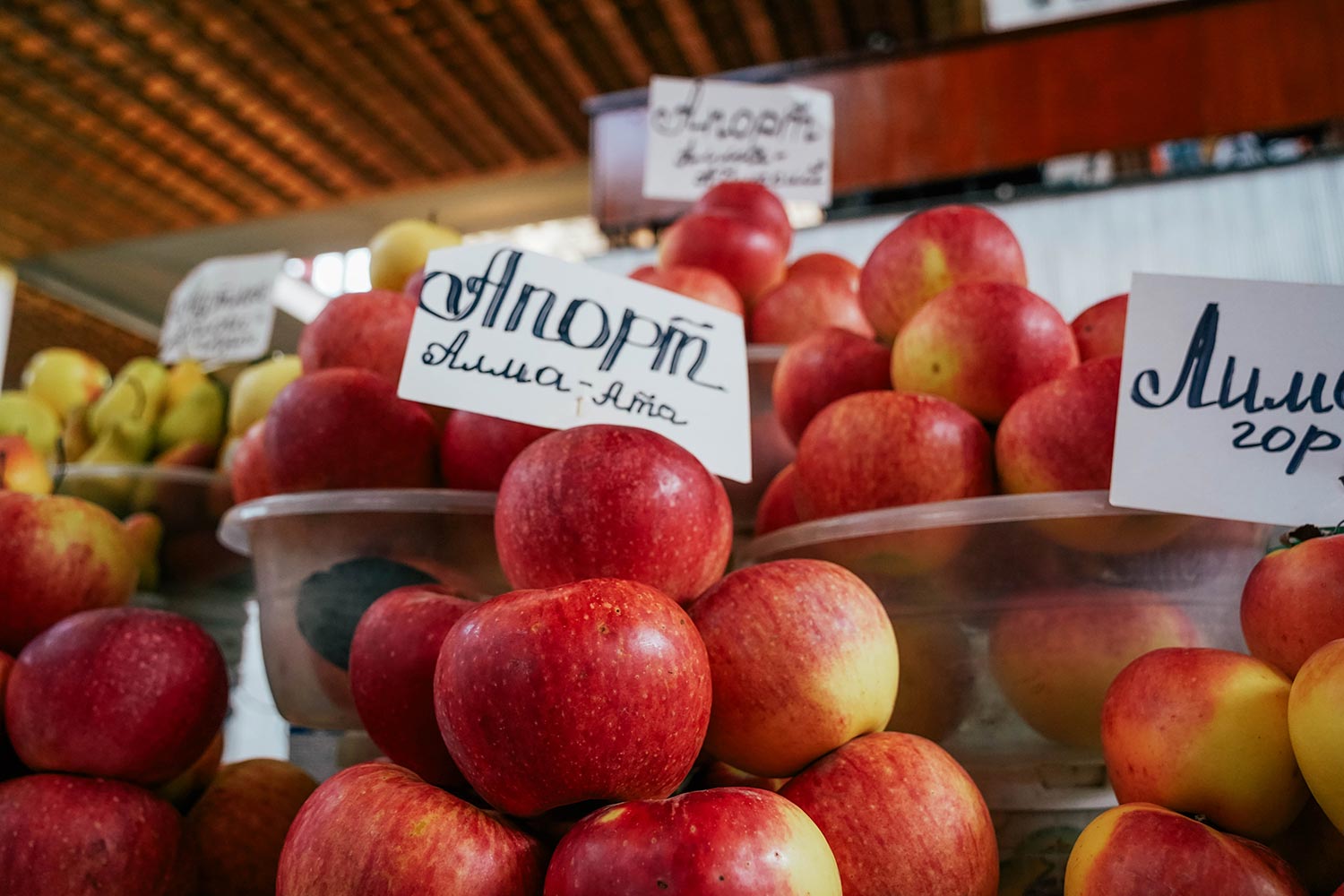
In September, the stalls of Almaty’s Green Bazaar are piled high with apples: pyramids of green, yellow and lacquered red. The most closely examined are the Aports, broad-shouldered fruit with mottled crimson skins.
A good Aport has pale, crisp flesh, a strong perfume and enough acidity to balance its sweetness; an indifferent one is simply large (they typically weigh 250–400 grams, roughly twice the weight of a typical supermarket apple). During their brief autumn season, identifying the difference becomes a minor city sport.
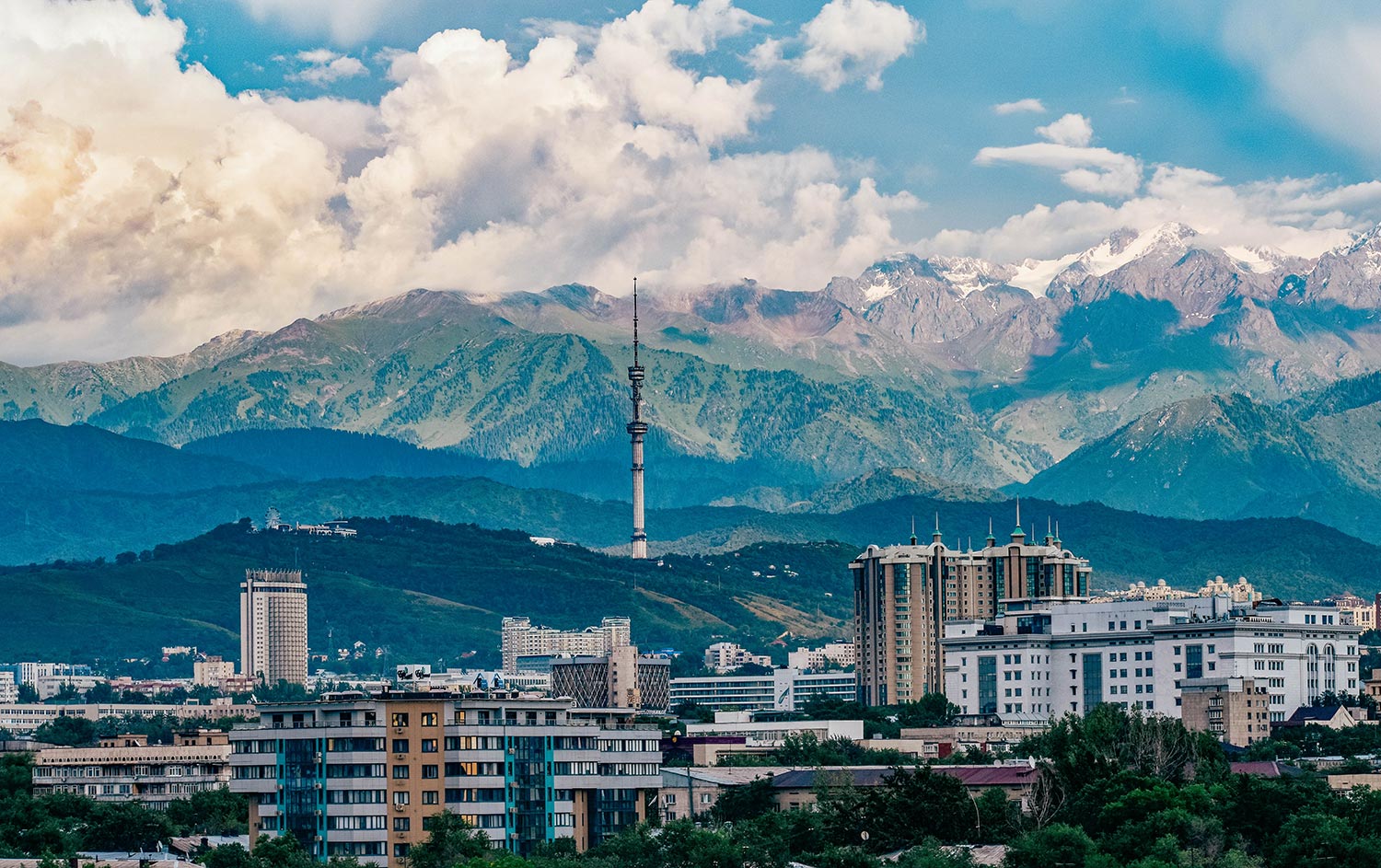
The apple is almost impossible to avoid in Almaty. It appears on murals, souvenirs and restaurant menus, while the city’s earlier Soviet name, Alma-Ata, was commonly translated as “father of apples”. Yet the fruit most associated with modern Almaty is not quite the ancient apple of the surrounding mountains.
The Aport was introduced from Russia in the nineteenth century and flourished when grafted onto local rootstock. The indigenous tree is Malus sieversii, the primary wild ancestor of Malus domestica. In genetic terms, this is where the modern apple begins: cultivated varieties grown around the world descend principally from these Central Asian trees, with other wild species contributing as apples travelled west.
It was not apples that first brought Alexander Thomas to Almaty, but a series of happy coincidences. Working as an aviation journalist, the Englishman flew there to interview Air Astana’s chief executive. On the flight back to London, he sat beside Aizhan, a Kazakh student travelling to Britain for her master’s degree. They married the following year and moved to Almaty in 2014.
Thomas had long imagined leaving journalism to make wine in southern France. Then Aizhan gave him Apples Are from Kazakhstan, whose account of the fruit’s Central Asian origins sparked the idea of making cider. He spent two years learning the craft and established Apple City Cider in 2016.
“Instead of pressing grapes in the South of France, we began pressing apples in Almaty,” he says.
Securing permission to begin production took several more years. Cider was then scarcely available in Kazakhstan, with no established route through the permits and approvals required for such an unfamiliar product.
Apple City Cider uses local fruit, including wild and semi-wild apples whose acidity, tannins and sugar content often make them better suited to fermentation than eating. Its range now includes Almaty Wild Apple Cider and a dry-hopped cider, while its production site near Talgar hosts privately arranged orchard walks, cidery visits and tastings.
The company has grown alongside the city’s broader evolution in its restaurant scene. Thomas remembers Almaty restaurants with sprawling 20-page menus and much the same selection from one establishment to the next. Over the past decade, chefs have begun exploring neo-nomad cuisine, a contemporary reinterpretation of Kazakh food.
Local cider has found a place within that shifting scene. Bartenders mix it into cocktails, chefs cook with it, and restaurants carry locally made bottles. “The entire Kazakh culinary scene is changing; it has absolutely transformed,” Thomas says.
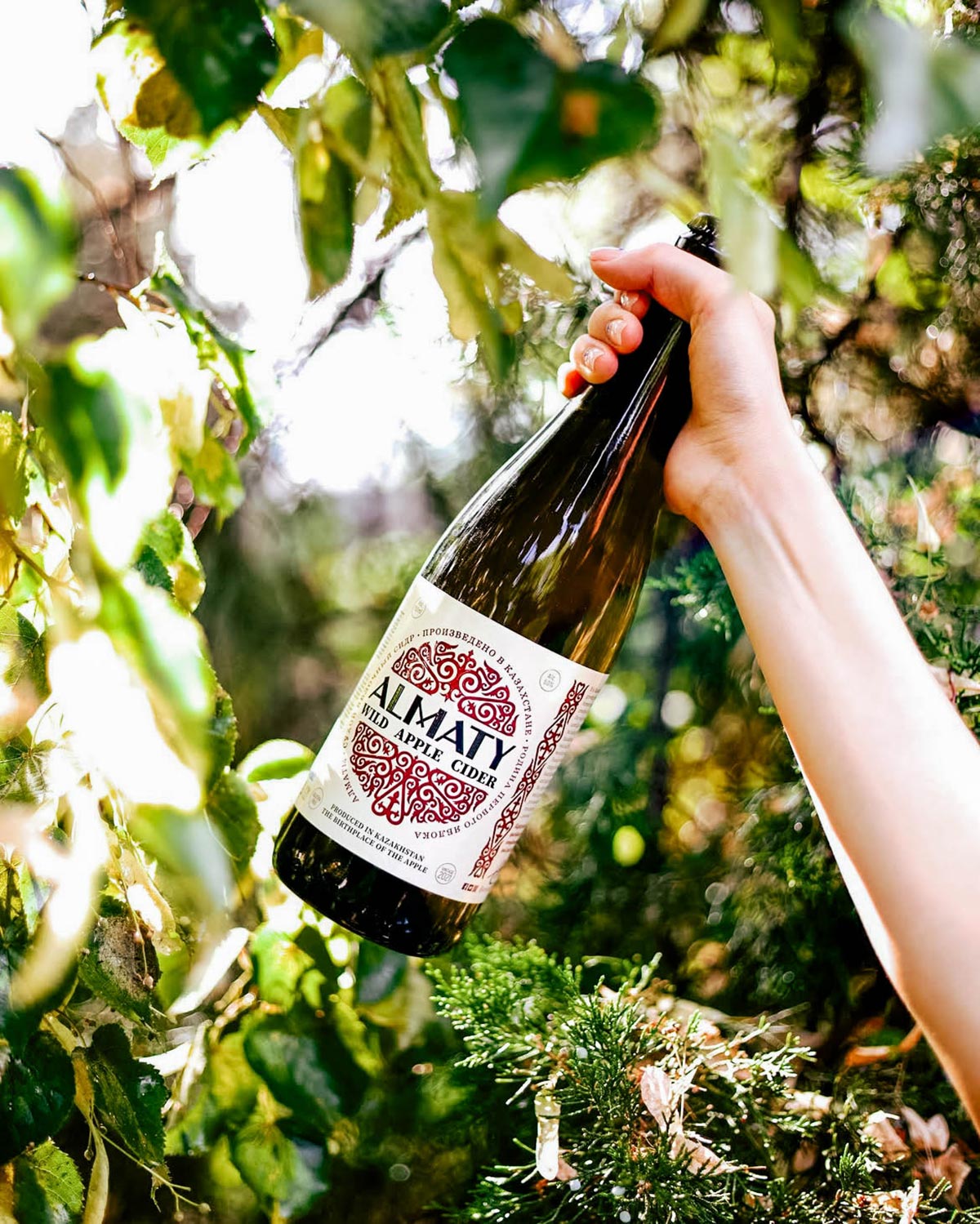
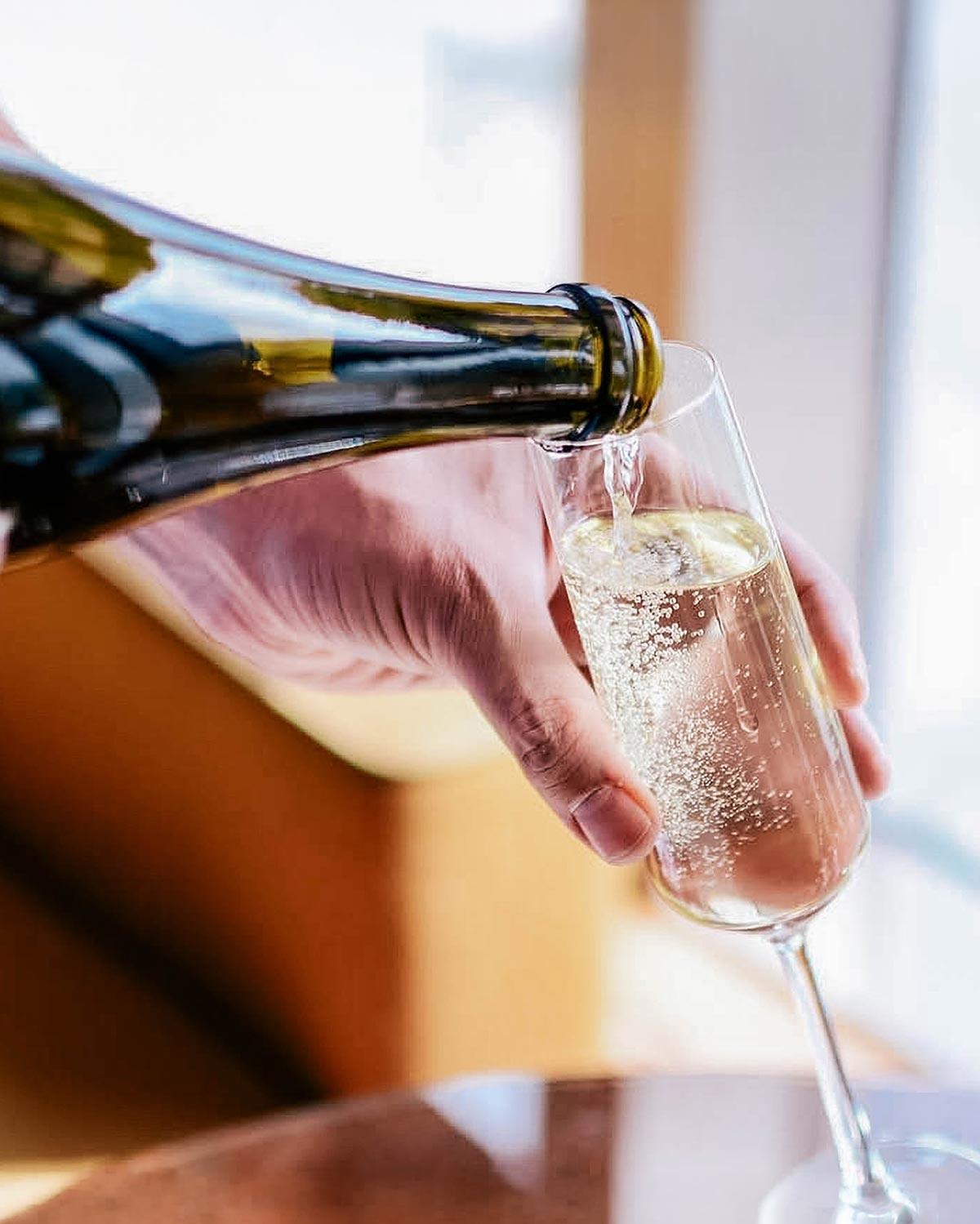
The apple has also become part of the way Almaty presents itself to visitors. At The Ritz-Carlton, Almaty, guests check in on the 30th floor over apple tea, with local Aports offered in season. After dark, the fruit reappears at Adept Cocktail Bar in the form of an Appletini.
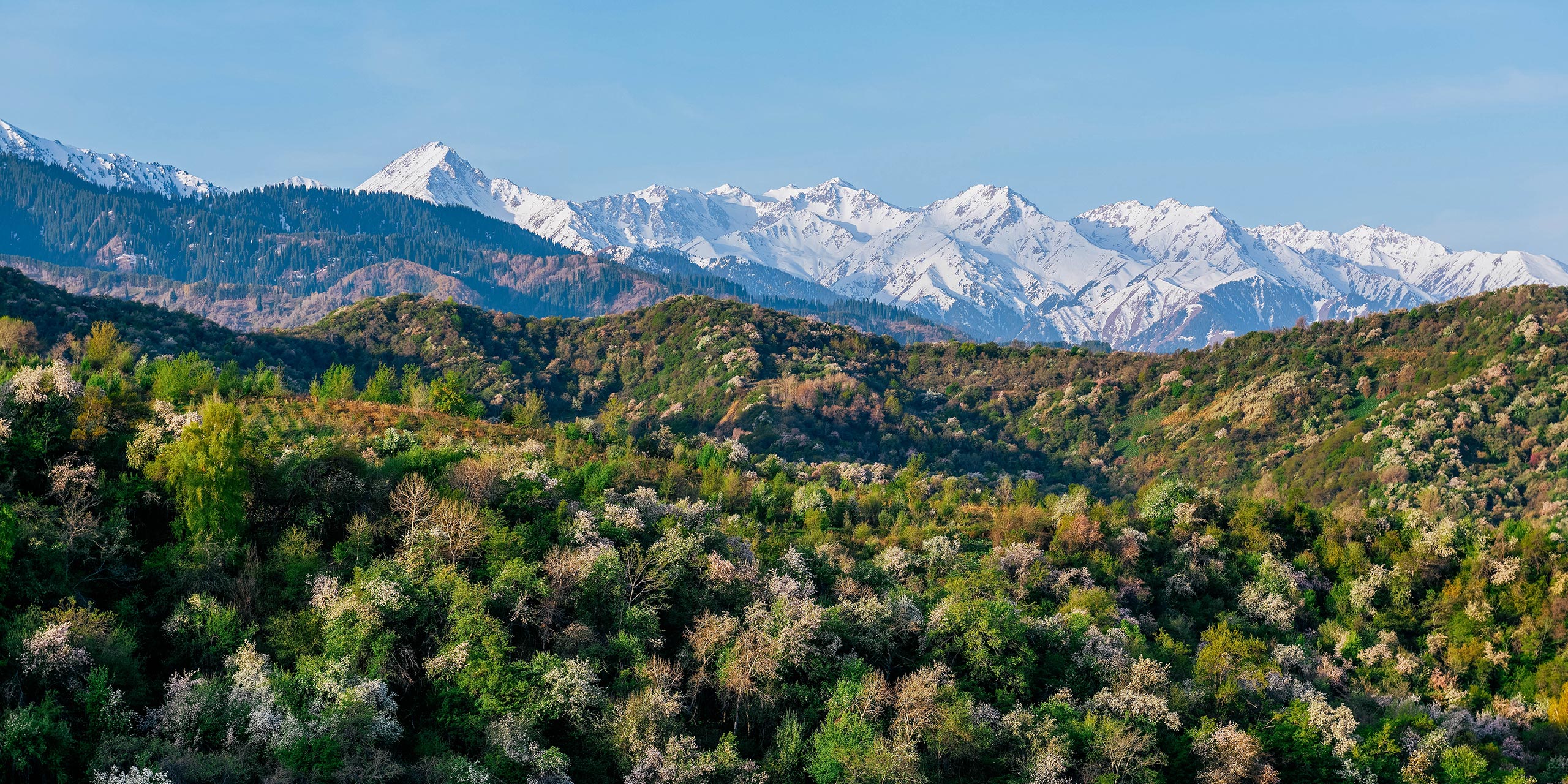
To find the fruit behind Almaty’s apple teas, cocktails and ciders, the route leads back towards the trees. Around eight kilometres southwest of Green Bazaar, the Main Botanical Garden occupies land that lay beyond the city limits when it was established in 1932. The city has since grown around it, and many of the orchards that once extended towards the mountains have given way to development.
The garden holds a six-hectare living collection containing more than 170 forms of Malus sieversii gathered from mountain populations. Some produce small, green and sharply sour fruit; others carry crimson apples with fragrant flesh and enough sweetness to eat straight from the tree. You can request visits to the wild-apple collection in advance.
East of the city, beyond Esik and Turgen, the trees return to their wilder setting in Kuznetsov Gorge, part of Ile-Alatau National Park. In June 2026, the park opened a scientific and educational trail dedicated to the Sievers apple, alongside a memorial information centre devoted to the legacy of Kazakh apple researcher Aimak Dzhangaliev.
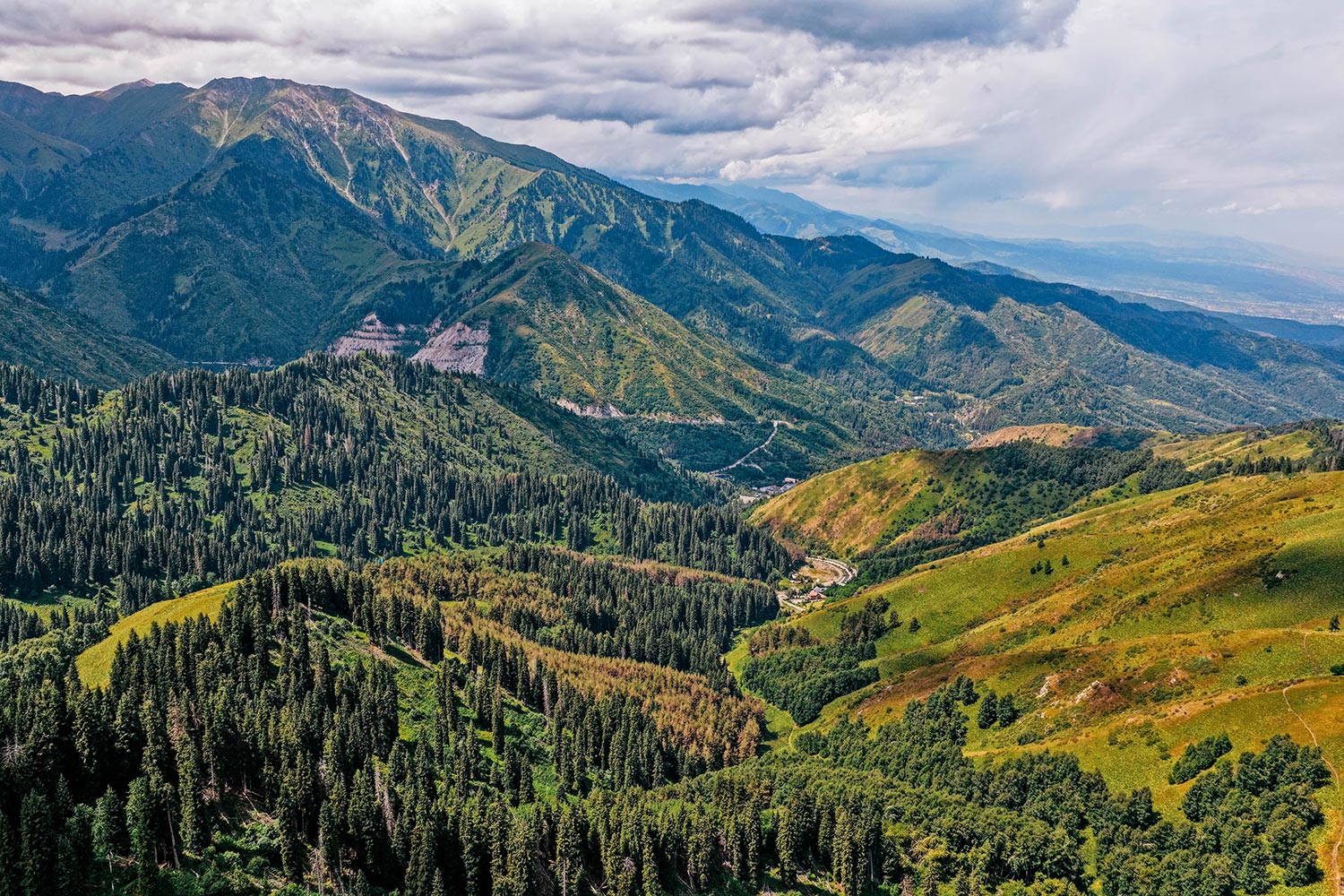
“This project will make it possible to combine tourism and scientific research to preserve the Sievers apple’s genotype for future generations,” Elnur Akhmetov, director general of Ile-Alatau National Park, told local media.
Past the village of Taldy-Bulak, asphalt gives way to a country road climbing into the foothills. Wild apple trees emerge from open meadows or gather among apricot, hawthorn, pear and elm. Some have stood for more than a century, their thick trunks and twisting branches gripping the slopes; higher up, spruce begins to take over. During the autumn harvest, fallen apples soften and ferment in the grass.
Here, the variation catalogued at the Botanical Garden appears without labels or orderly rows. One tree may carry small, green and bitter fruit; its neighbour, red-skinned apples sweet enough to eat. Wild, feral and hybrid trees occupy the same slopes, producing abrupt changes in shape, texture and flavour.
That diversity is partly the result of the apple’s unusual journey. Animals first carried seeds away from parent trees; humans later assumed that role, moving apples across Central Asia, the Caucasus, the Middle East and Europe and bringing previously isolated populations into contact.
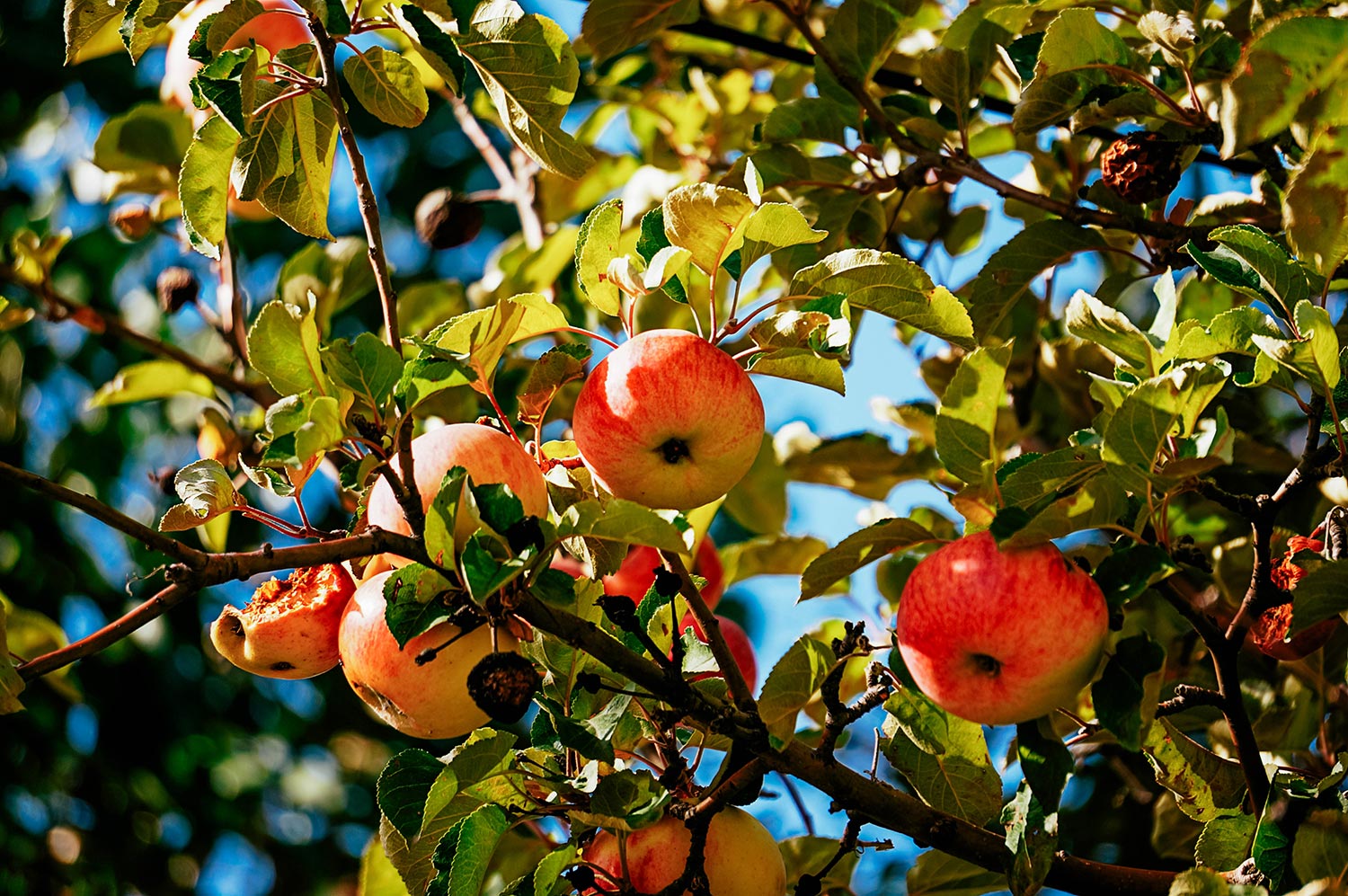
“Humans did not actually domesticate the apple,” archaeobotanist Robert Spengler wrote in a recent essay. Instead, we changed its evolution “simply by moving the plant from point A to point B.”
Because a tree grown from seed rarely reproduces its parent faithfully, growers learned to preserve favoured apples through grafting. Every named cultivar is therefore one successful individual reproduced across generations; in the wild forest, each seed creates a new genetic combination.
This makes conservation a matter of protecting the forest as a living system rather than preserving a few exemplary trees. Wild populations may contain traits capable of helping future orchards withstand frost, drought, pests, and disease. Yet Malus sieversii is classified as Vulnerable, threatened by development, grazing, fire, disease, and interbreeding with cultivated trees. The forest holds both the apple’s past and some of its possible futures.
Near Esik, Yagoda Issyk, a working orchard and nursery, is helping restore the Aport, a cultivar whose fortunes have long been bound to the wild tree. During the late-summer and early-autumn harvest, the farm opens by arrangement for small-group visits and pick-your-own days.
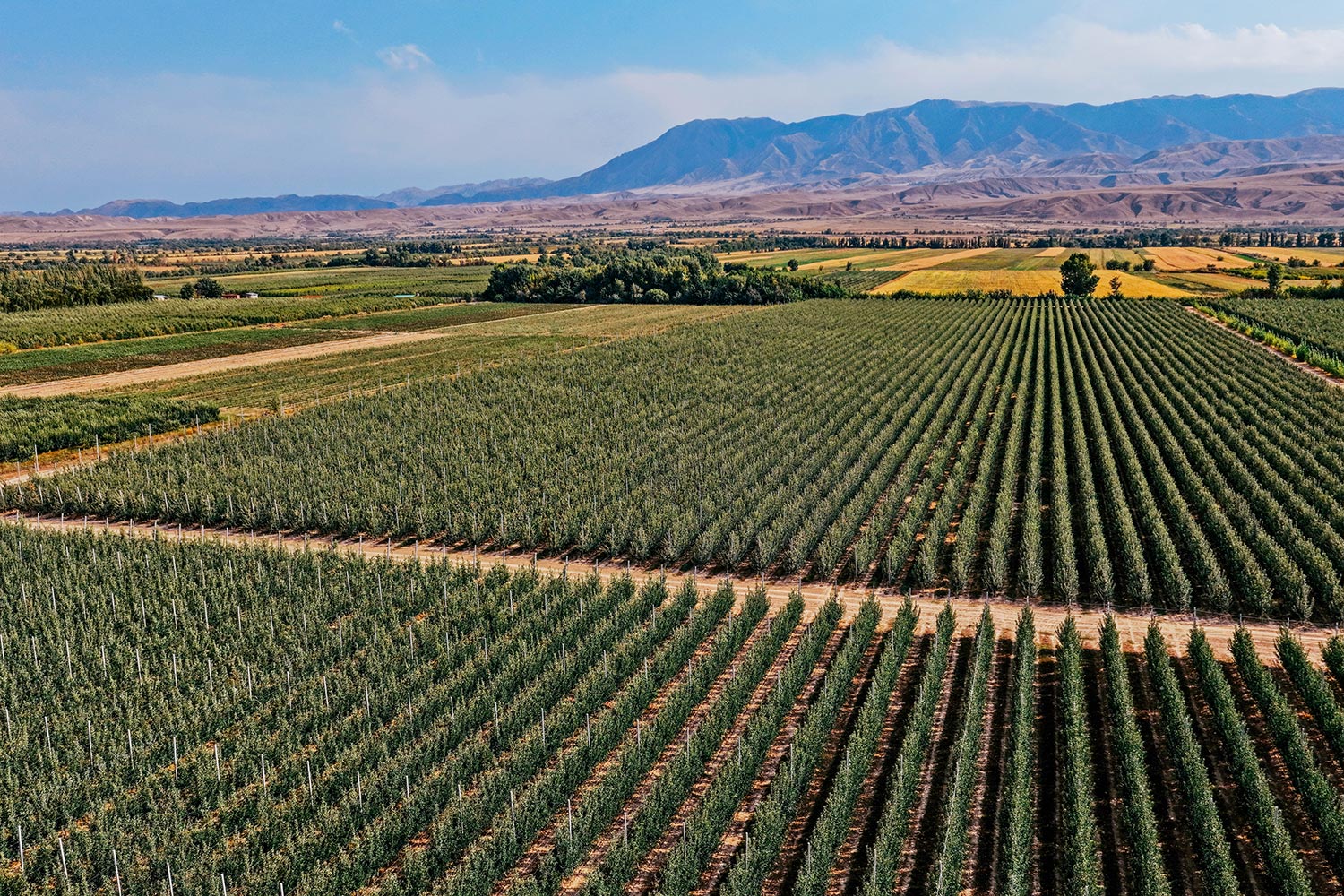
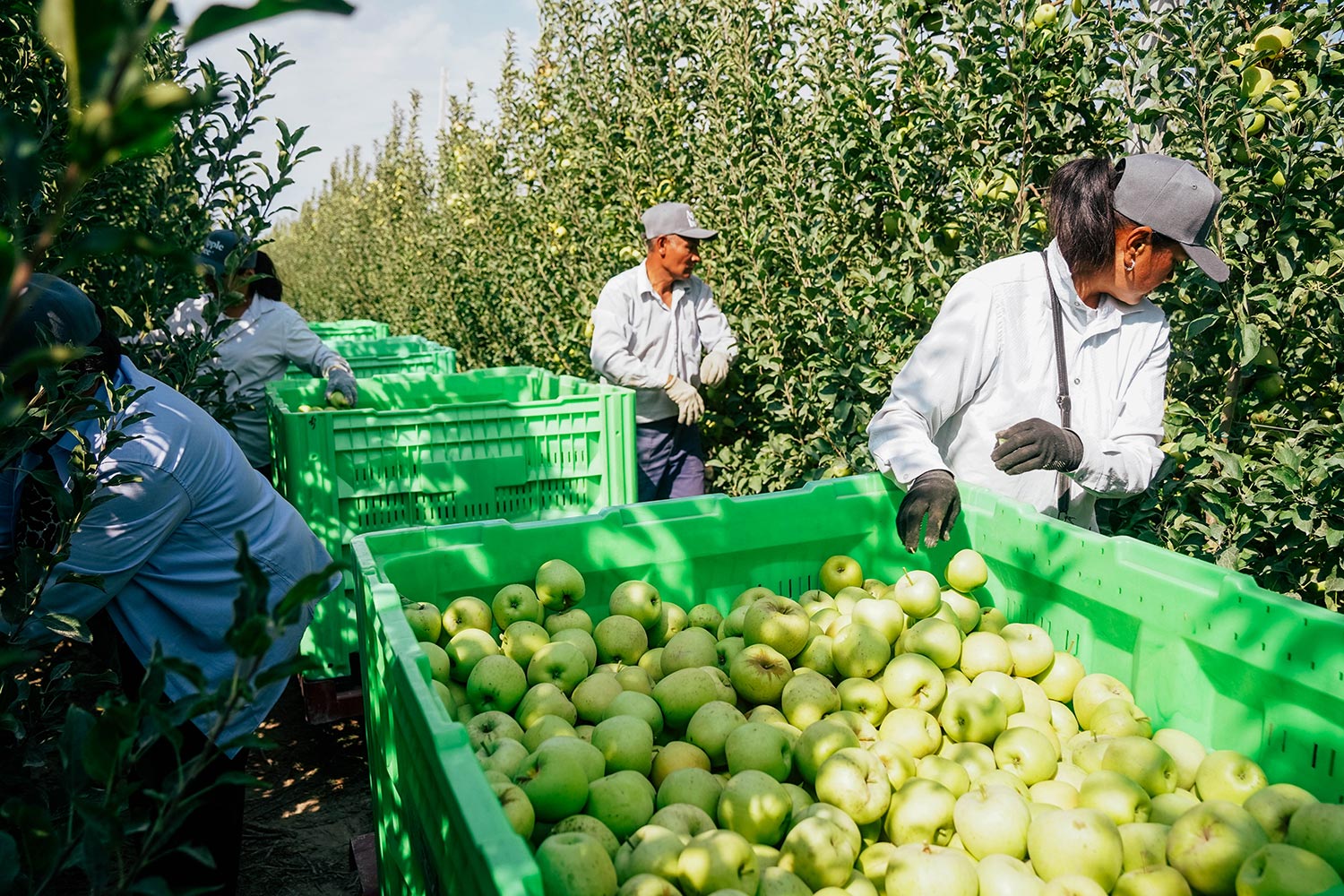
Grafted onto Malus sieversii rootstock and cultivated on the northern slopes of the Trans-Ili Alatau, the Aport developed the size, colour and fragrance that made it synonymous with Almaty. Roman Safarov, president of the Almaty Aport Producers Association, describes its “pleasant aroma, which is not found in any other variety of apples” and “a characteristic crunchy sound when you bite into it.”
Aport trees are delicate and demanding. Even with the right care, they do not begin bearing fruit until their eighth or ninth year. As commercial orchards turned to earlier-bearing and more productive varieties, the Aport survived largely because some growers were prepared to wait.
Restoring it will require the same patience on a larger scale. Under a state revival programme running to 2028, 2,080 Aport seedlings have been raised, with Aport orchards intended to cover 110 hectares by 2027. At Yagoda Issyk, that long horizon is visible in rows of young trees planted for harvests that will not come until well into the next decade.
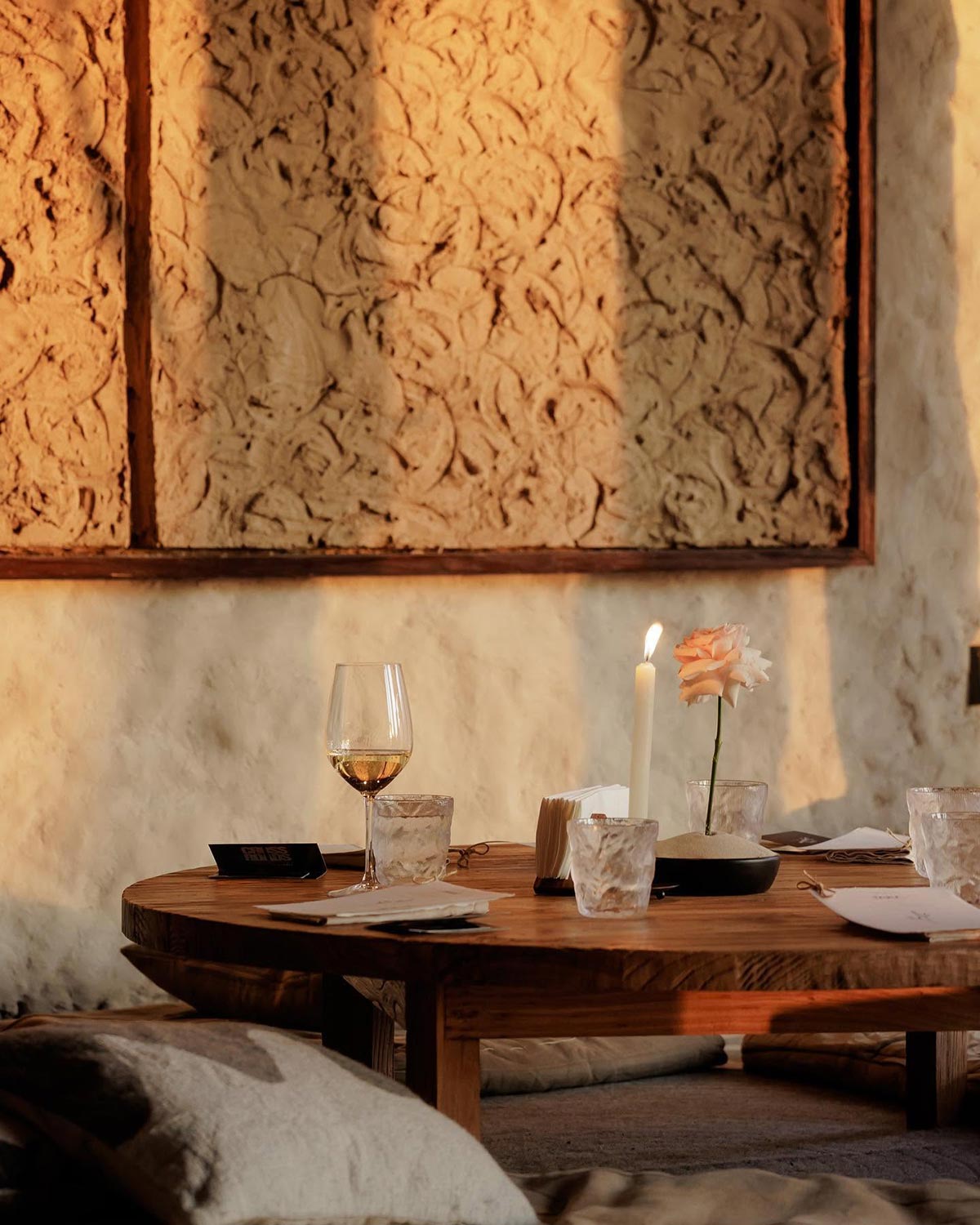
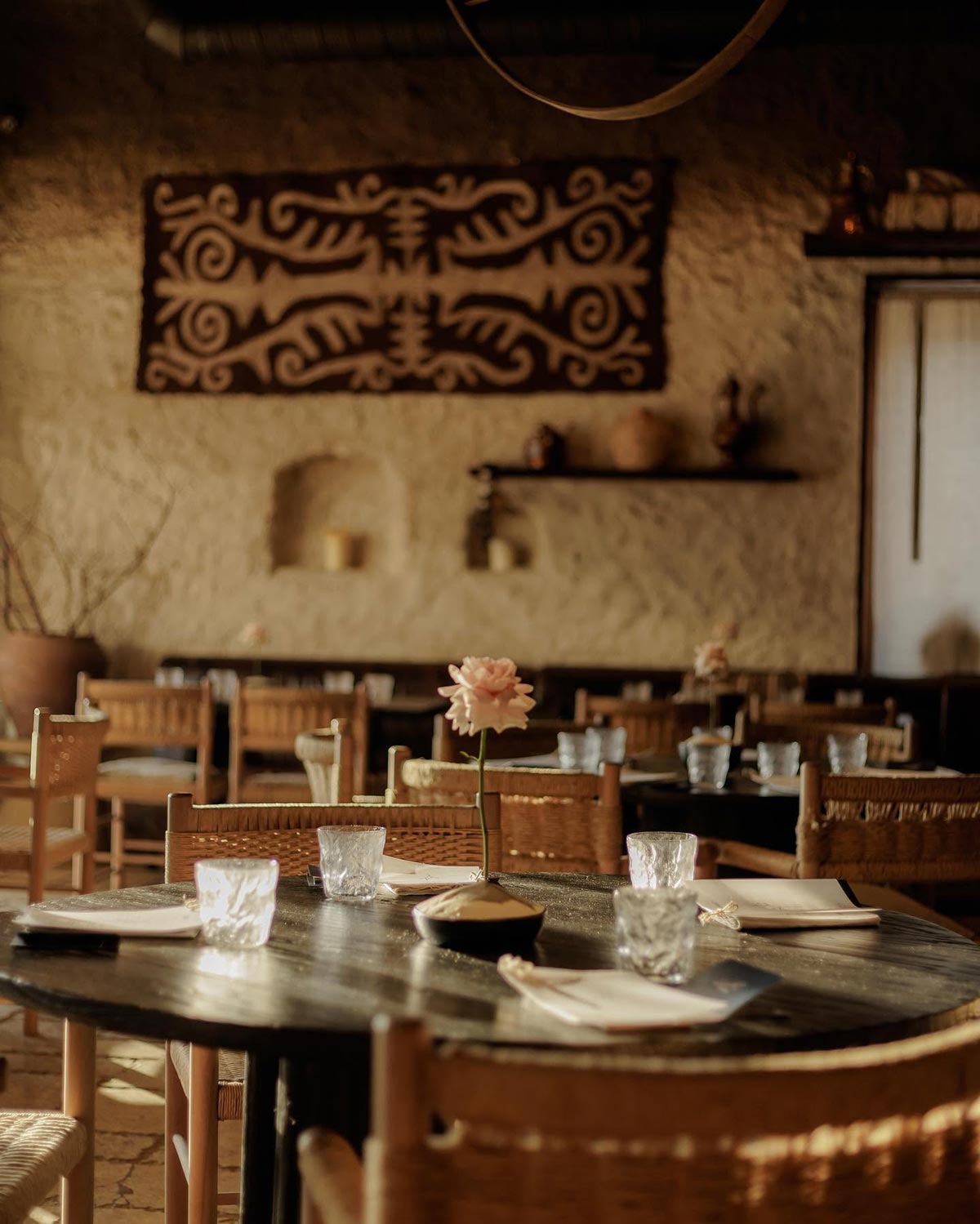
From Esik, the road west follows the northern foot of the Trans-Ili Alatau towards Almaty. At the city’s southern edge, it turns uphill into Medeu Gorge. Among its spruce-clad slopes, neo-nomad restaurant AUYL occupies a yurt-style Soviet-modernist pavilion relocated from Aktau on the Caspian coast and remade by Kazakh architects, artists and artisans. In 2024, Prix Versailles selected it as one of the world’s 16 most beautiful restaurants.
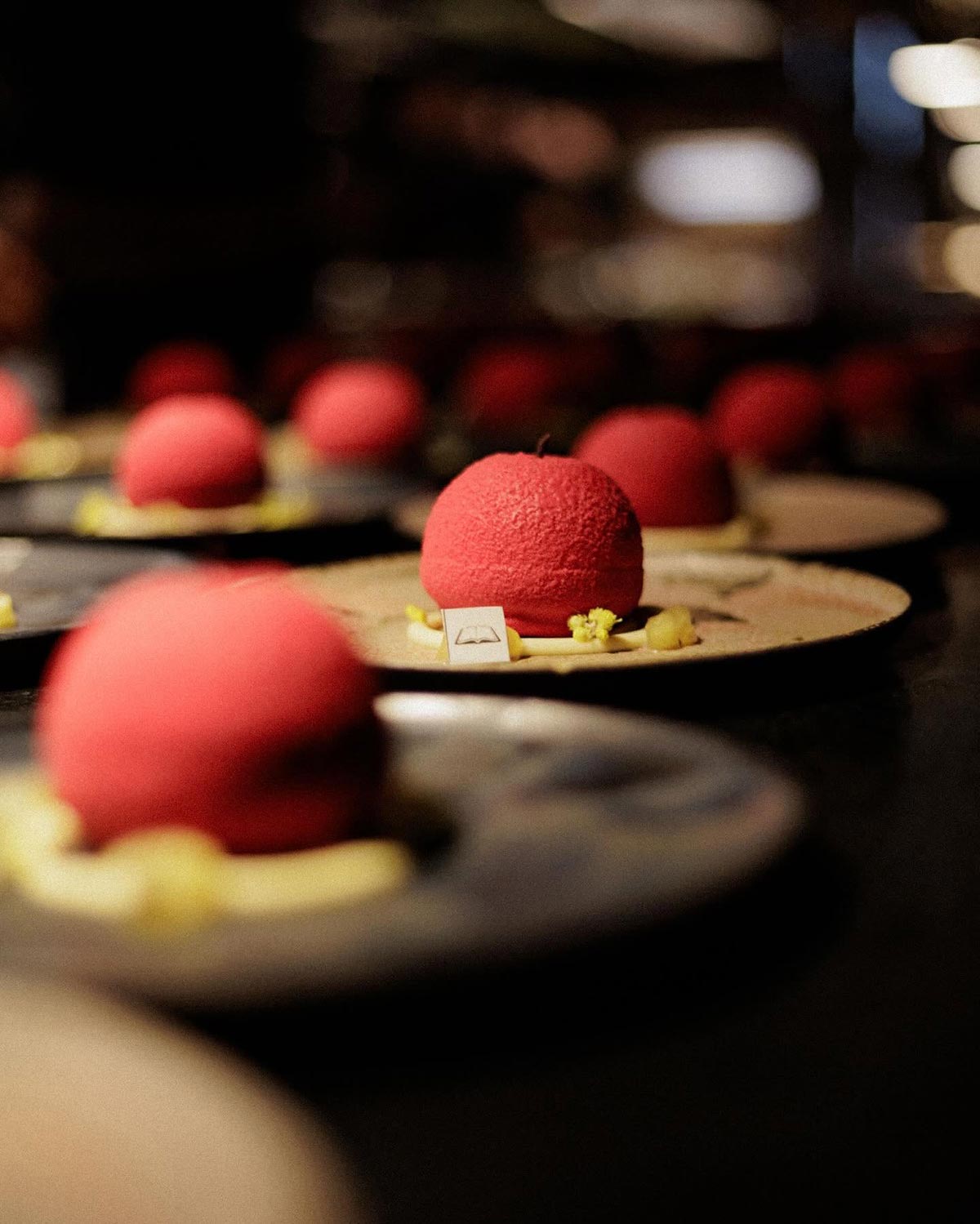
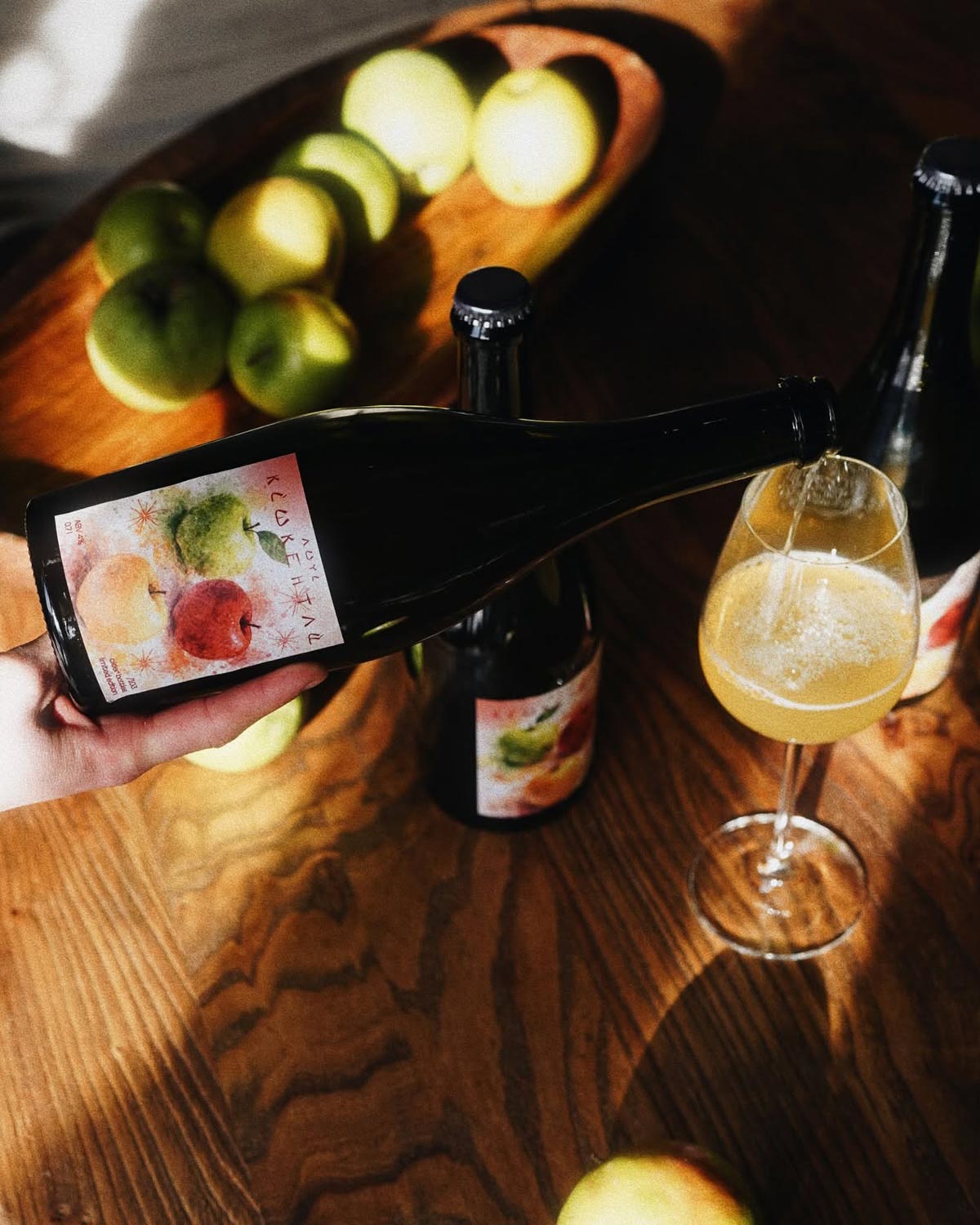
AUYL’s signature Alma dessert arrives disguised as a small red apple. Crack its thin white-chocolate shell, and it gives way to mousse and cinnamon-spiced pear. A natural Kazakh cider from Arba Wine is poured alongside it.
That an established Kazakh winemaker now makes cider, and that AUYL pours it, is a small measure of the drink’s movement into the country’s wider food-and-wine culture during the decade since Thomas began pressing apples.
Above the city, wild trees continue to cast fruit into the grass, each seed carrying a different possibility. Almaty’s apple story did not end when the fruit travelled west; it is still blossoming beneath the mountains where it all began.